Monday, May 31, 2010

Butterfly wings to fight banknote forgery

A butterfly wings might be a way to fight banknote forgery. Expert at University of Cambridge have made realistic imitation copies of the butterfly’s wings after studying the Indonesian Peacock Swallowtail butterfly. Brightly coloured patterns on the insects can now be reproduced on banknotes and passports to minimise the risk posed by fraudsters. Mimicking these iridescent patterns has long eluded scientists as they are produced by light bouncing off microscopic structures in the insects’ wings. The study is published in Nature Nanotechnology journal.
Photo by wikipedia: The butterfly in the study; Indonesian Peacock Swallowtail butterfly.

The butterfly in the study; Papilio blumei is found only on the island of Sulawesi in Indonesia and has a wingspan of three to three-and-a-half inches. The wings of the Swallowtail have an intricate, microscopic make up resembling the structure of an egg carton. It is due to their shape and the alternate layers of air and cuticle within the wings that they produce such depth and intensity of colour. But scientists found a way to produce structurally identical replicas of butterfly scales. The copies are created in the lab from a combination of nanofabrication procedures including self-assembly and atomic layer deposition.

Mathias Kolle, who led the research, said: “We have unlocked one of nature’s secrets and combined this knowledge with state-of-the-art nanofabrication to mimic the intricate optical designs found in nature.

“Although nature is better at self-assembly than we are, we have the advantage that we can use a wider variety of artificial, custom-made materials to optimise our optical structures.

“These artificial structures could be used to encrypt information in optical signatures on banknotes or other valuable items to protect them against forgery.

Next time when we hold a banknote in our hand, please remember to say thank you for butterfly as well. They help us stop counterfeit banknote from circulating. As in Malaysia, many counterfeit new RM50 counterfeit cases emerging everyday. Just make sure you check your money before put them in your wallet.

Source: Telegraph.co.uk, Wikipedia.

Related Posts:
Read More

Saturday, May 22, 2010

World's most expensive coin: 1794 silver dollar

A 1794 silver dollar become a new world's most expensive coin this week. The Neil/Carter/Contrusi 1794 flowing hair dollar, sold for $7.85 million to the Cardinal Collection Educational Foundation of Sunnyvale by Steven L. Contursi, who has owned the mint-condition 1794 Liberty dollar for the past seven years. The Name "Neil/Carter/Contrusi 1794 flowing hair dollar" came from the previous owner of the coin. The previous record price paid for a coin was $7.59 million for a U.S.-minted 1933 $20 double eagle gold piece, according to the American Numismatic Association.
1794 dollar
The U.S. began producing silver dollars in 1794, and this particular one remains in near-perfect condition 216 years later. Of the approximately 1,750 such dollars produced that year, only about 150 are known to exist. The quality of the imprint on this one shows it was struck on a hand-cranked press from a special piece of polished, high-quality silver. That indicates it was intended for either a dignitary or the mint's own private collection, said Larry Shepherd, executive director of the American Numismatic Association. It likely remained in the mint's collection until the 1800s, Shepherd said, when it was probably traded to a private collector, something he said the mint sometimes did in those days. The Flowing Hair Dollar is slightly larger and heavier than later coins such as the Morgan or Peace dollars.

"That's the type of piece that is available maybe once in a lifetime," said Martin Logies, curator of the Cardinal Collection, a nonprofit dedicated to preserving rare coins and educating the public about them. He said the foundation plans to put the coin on display, just as Contursi did much of the time he owned it.

Numismatic experts say it was among the first U.S. silver dollars ever made.

"From the research I've done, it is unquestionably the earliest struck of all the pieces known to remain in existence," said Logies, author of "The Flowing Hair Silver Dollars of 1794."

Contursi, who runs Irvine-based Rare Coin Wholesalers, acquired it for an undisclosed sum in 2003. He said he wasn't looking to sell it until Logies approached him. The Cardinal Collection curator had been one of a handful of experts Contursi had allowed to examine the coin after he bought it. He joked that Logies had had his eye on it ever since.

"He just finally made me an offer I couldn't refuse," he laughed.

expensive coinOn the obverse: The engraver Robert Scot created the silver dollar with a portrait of a young female facing the right with her hair flowing freely behind her to the left. The word “LIBERTY” was positioned above her with the date centered below. Fifteen starts appear along the sides to represent the fifteen states at the time. It has been accepted that the flowing hair was meant to stand for freedom.

On the reverse: The dollar coin shows a small eagle perched upon a rock with wings spread and surrounded by laurel branches. Along the border is the motto “United States of America.”

On the edge: Has the words “HUNDERED CENTS ONE DOLLAR OR UNIT” inscribed with decorations separating the words.

Source: Associated Press, Rare Coin Wholesalers. All Photo by Rare Coin Wholesalers.

Read More

Friday, May 21, 2010

Britain bans 500 euro notes


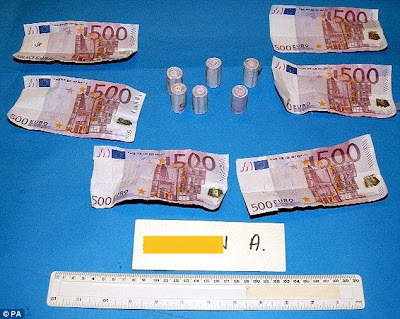
Britain already bans 500 euro notes from sale by bank wholesalers last week due to the notes being used by organised crime. The decision to end trading was made after police found nine out of every 10 of the notes in circulation are linked to crime, tax evasion and terrorism. The banknote itself already earned the name "bin laden" due to its popularity among criminal in UK. It is called "bin laden", because you know it's out there, you know what it looks like, it moves around a lot but no-one ever sees it.

euro notes
Photo by dailymail.co.uk: a roll of 25,000 euro notes.

An adult male can stuff and swallow 150,000 euros and 20,000 euros can be hidden in a cigarette packet. One million pounds in £50 notes is made up of 20,000 individual notes and weighs 50kg. But one million pounds in 500 euro notes is just 2,300 notes and weighs little more than 2kg. In February members of a gang of Iraqi Kurds were jailed for up to five years for laundering £25million in drug profits. The gang used foreign exchange bureaus to change the cash into 500 euro notes. Rolls of notes were stuffed into cereal boxes each holding 300,000 euros.
smuggle euro
Photo by Dailymail.co.uk: large amount of 500 euro notes hidden in a car.

Investigators said a small number of backstreet cash wholesalers have been profiting from exchanging large quantities of money for crime gangs. Up to 500,000 euros may change hands in one transaction as criminals shrink suitcases full of Sterling to a briefcase of euros. A second Soca official said there are ''pockets of complicity'' among a small number of wholesalers who turn a blind eye to the trade. He said the traders, who often operate in tourist and transport hubs, are mostly based in large cities including London, Birmingham and Glasgow.
500 euro
Photo by dailymail.co.uk: 500 euro notes.

The Serious Organised Crime Agency (SOCA), which coordinated the voluntary industry move, said there is ''no credible legitimate use'' for the note in Britain. Officials have been watching the market for signs of criminals changing tactics since trading secretly stopped about one month ago. They have been expecting to see drug smugglers, people traffickers and other top-level crime gangs struggling to launder their profits as a result. The distinctive pink and purple note is a favourite with criminals because it takes up less space than other currencies and is accepted across the continent. Tourists and other legitimate customers will not be affected by the changes and the 500 euro note remains legal tender.

Source: Dailymail.co.uk, Telegraph.co.uk, BBC News.

Read More

Thursday, May 20, 2010

Russia largest gold coin

The Central Bank of The Russian Federation (Russian: Центральный банк Российской Федерации) will issue a 5 kg commemorative gold coin to mark its 150th anniversary next month. The 50,000 rubles coins will be issued after 12 June 2010, and minted in .999 proof condition. Only 50 pieces of this coins will be issued and additional coins will be minted according to demand. The price of the coin will be decided according to current gold market price. According to news, there is a plan to produce a 150 kg coins but due to limited capabilities of Goznak coin minting enterprises, the idea cannot be carried out.

The obverse of the gold coin in denomination of 50000 Rubles: framed by a stylized circle - the relief image of the Emblem of the Bank of Russia - the two-headed eagle with wings down and the semicircular inscription under it "БАНК РОССИИ" (BANK OF RUSSIA), lower, under the Emblem - the year of issue "2010" and the relief images of the State Emblems, used in banknotes’ designs since the State Bank was founded (the State Emblem of the Russian Empire, the Emblem of The Provisional Government of Russia, the State Emblems of the RSFSR and USSR). At the top, over the Emblem – the indication of the denomination of the coin “ПЯТЬДЕСЯТ ТЫСЯЧ РУБЛЕЙ” (FIFTY THOUSAND RUBLES), at the bottom - the indication of the metal according to the D.I. Mendeleyev Periodic System of Elements, the purity, the trade mark of the Saint-Petersburg Mint and the fine precious metal content and the original number sign of the coin.

The reverse of the 50000 Rubles gold coin contains the relief images of the portraits of the Emperor Alexander the II, the first State Bank managers - A.L. Shtiglits (1860-1866) and E.I. Lamanskiy (1867-1881), performed in the patterned medallions, of the Saint-Petersburg Regional branch building (1860-1918) and of the griffins, decorating the Bank Bridge in Saint-Petersburg on the Griboedov Canal. At the bottom there is the inscription “THE BANK OF RUSSIA FOUNDED IN 1860”.

Even though this coin cannot break world largest gold coin of 100 kg by Canada, at least they try. I am still waiting for any news about Malaysia new commemorative for this year. Its been a while since Bank Negara Malaysia produce new commemorative. Maybe BNM a little bit busy with their new RM1 notes project and money museum.

Source: Central Bank of The Russian Federation, 

Related Posts:


Read More

Wednesday, May 19, 2010

RM1 banknote survey

Bank Negara Malaysia (BNM) is seeking public opinion on the usage of RM1 banknote. The survey conducted by BNM is intended to measure public opinion on the use of RM1, which is the lowest currency denomination Malaysia. The survey took about 5 minutes to finish (I finish it under 1 minute). The survey has been released since 13 May 2010 by Department of Currency Management and Operations, BNM. BNM said that this survey is important in helping BNM to determine the substrate of a new RM1 banknote.


What I can see from the survey is that so many question about Polymer banknote. Look like most probably the new RM1 banknote will be in polymer? or BNM already produce them and just asked people opinion as a hint to what the new banknote will be? There is no option for any kind of substrate that people can choose that they will like for a new RM1 banknote. It is no point asking a question, if you already printed the answer BNM.

Malaysian never had any RM1 polymer before why BNM asked question like:
  • Wang polimer RM1 lebih bersih daripada wang kertas RM1.
  • Wang polimer RM1 tidak mudah koyak melainkan dirosakkan dengan sengaja menggunakan pisau, gunting atau stapler, berbanding wang kertas RM1.
  • Wang polimer RM1 mudah dikira dengan tangan seperti mana wang kertas RM1.
  • Wang polimer RM1 mudah dikira menggunakan mesin pengira matawang.
  • Wang polimer RM1 mudah diterima pakai oleh mesin vending/layan diri.
  • Wang polimer RM1 tidak mudah menguncup/kecut melainkan didedahkan dengan sengaja kepada suhu tinggi/panas.
BNM should asked people opinion about current RM5 polymer not something that does not exist yet. There is no option for language in this survey. If you cannot read Malay, then most probably you cannot join this survey.

To anyone who still have not take the survey, you can check BNM website or click this link on: the link has been deleted.


Read More

Friday, May 14, 2010

Shanghai Expo: Australia Shaped Silver Coin

Another different shape coin by Perth Mint, Shanghai expo 2010: Australia shaped Silver bullion coin.The Perth Mint has struck Australia’s official commemorative coins for the Shanghai World Expo 2010, taking place between 1 May and 31 October. Authorised by the Department of Foreign Affairs and Trade, each coin in the program celebrates the Australian pavilion, where engaging exhibits and unique attractions are showcasing Australian innovation, creativity and achievement. This coin is struck from 1oz of 99.9% pure silver in bullion quality.
Made in the shape of the Australian continent, the coin’s reverse portrays a coloured depiction of Peng Peng, the Australian pavilion's kookaburra mascot, and the Chinese characters for ‘Australia’. The design includes the Australian pavilion’s colourful logo - a representation of the Australian continent in three wavy lines symbolising the blue sea and sky, red centre and golden beaches. The coin’s reverse also incorporates The Perth Mint’s ‘P’ mintmark.
Issued as legal tender under the Australian Currency Act 1965, the coin’s obverse depicts the Ian Rank-Broadley effigy of Her Majesty Queen Elizabeth II and the 2010 year-date.
Specifications:
Silver Content (Troy oz) 1
Monetary Denomination (AUD) 1
Fineness (% purity) 99.9
Minimum Gross Weight (g) 31.135
Maximum Diameter (mm) 40.60
Maximum Thickness (mm) 4.00
Designer Wade Robinson
Limited to a mintage of 30,000, this Shanghai World Expo 2010 silver coin is subject to an exclusive distribution agreement in China. Under a special arrangement, however, 1,000 coins can be issued by The Perth Mint for sale worldwide. Each coin is housed in a presentation case which comes in a colourfully illustrated box-shipper. Each coin also accompanied by a numbered Certificate of Authenticity.
Source: Perth Mint, Wikipedia
Related posts:
Read More

Thursday, May 13, 2010

Australian sea life 1/2 oz silver proof Moray Eel

This month, Perth Mint is releasing Australian sea life 1/2 oz silver proof Seahorse, the last coin in the series. Three of the coins release in the same series before this (lionfish, leafy sea dragon and clownfish) has already been sold out, the Seahorse coin is still available. The coin is struck by The Perth Mint from 1/2oz of 99.9% pure silver in proof quality. The Australian mottled moray (in Australia), and mottled moray (in New Zealand), Gymnothorax prionodon, is a moray eel of the family Muraenidae, found at depths down to 80 m. Their length is between 80 and 150 cm.
Moray eels are cosmopolitan eels of the family Muraenidae. The approximately 200 species in 15 genera are almost exclusively marine, but several species are regularly seen in brackish water and a few, for example the freshwater moray (Gymnothorax polyuranodon) can sometimes be found in freshwater.[2] With a maximum length of 11.5 centimetres (4.5 in), the smallest moray is likely the Snyder's moray (Anarchias leucurus), while the longest species, the slender giant moray (Strophidon sathete) reaches up to 4 metres (13 ft). The largest in terms of total mass is the giant moray (Gymnothorax javanicus), which reaches almost 3 metres (9.8 ft) and can weigh over 36 kilograms (79 lb).
The coin’s reverse portrays a Moray Eel in colour. Contrary to the impression given by its snake-like body, long sharp teeth and open-mouth, the Moray Eel is not an aggressive fish. Although capable of delivering a nasty bite, its mouth is generally open so that water can pass over its gills.The coin’s reverse includes The Perth Mint’s ‘P’ mintmark.

Issued as legal tender under the Australian Currency Act 1965, the coin bears the Ian Rank-Broadley effigy of Her Majesty Queen Elizabeth II and the 2010 year-date on the obverse.

Technical Specifications:
Silver Content (Troy oz) 0.5
Monetary Denomination (AUD) 0.5
Fineness (% purity) 99.9
Minimum Gross Weight (g) 15.573
Maximum Diameter (mm) 36.6
Maximum Thickness (mm) 2.3

This coin is available online and no more than 10,000 Moray Eel coins will be released by The Perth Mint. Each coin is housed in a presentation case which comes in a colourfully illustrated box-shipper. When lined-up in release order, the shipper illustrations form a linked image depicting all five reef creatures. Each coin also accompanied by a numbered Certificate of Authenticity.

Source: Perth Mint, Wikipedia

Related posts:
Read More

Wednesday, May 12, 2010

Queen Margrethe II 70 Years Gold coin

Issued on March 15, this commemorative coin marks the 70th birthday of Her Majesty Queen Margrethe II on April 16, 2010, and follows a Danish tradition of issuing commemorative coins to mark special events in the royal family. Margrethe II (Margrethe Alexandrine Þórhildur Ingrid, sometimes anglicised as Margaret II) (born 16 April 1940) is the queen regnant of Denmark. In 1972 she became the first female monarch of Denmark since Margaret I, ruler of the Scandinavian countries 1388-1412 during the Kalmar Union. The coin have a face value of 1000 kroner and minted in 9.00 gold Proof finish.

1000 KronerPrincess Margrethe was born at Amalienborg Palace, to Crown Prince Frederik and Crown Princess Ingrid. At the time of her birth, only males could ascend the throne of Denmark, owing to the changes in succession laws enacted in the 1850's when the Glücksburg branch was chosen to succeed. As she had no brothers, it was assumed that her uncle Knud would one day assume the throne. The process of changing the constitution started in 1947, when it became clear that Queen Ingrid would have no more children. At this time, Margrethe's uncle, Prince Knud, was the Heir Presumptive, but the popularity of Frederik and his daughters and the more prominent role of women in Danish life started the complicated process of altering the constitution.

Margrethe IIThe obverse design features a new portrait of the Queen by sculptor Lis Nogel. This new portrait is also meant to be used on the ordinary 10 and 20-krone coins starting in 2011. The reverse was designed by Ronny Andersen, Royal Armorist, and shows the royal coat of arms set against a background of daisies – a reference to the Queen's nickname, Daisy.

Specifications:
  • Item Number: 10DKAUBU1
  • Mint: Royal Danish Mint
  • Denomination: 1,000 Kroner
  • Quality: Proof
  • Issue limit: N/A
  • Alloy: 90% gold
  • Diameter: 22 mm
  • Weight: 8.65 grams
  • Reverse Design: Ronny Andersen
  • Obverse Design: Lis Nogel
  • Box/Capsule: Yes/Yes
  • Certificate: Yes

This coin is available online at The Royal Scandinavian Mint website.


Read More

Tuesday, May 11, 2010

Europa 2010: 200 € Gold Proof 1 Oz

The French Mint already issued this Europa 2010 - 200 € Gold Proof 1 Oz for the Europa series, its already sold out. Monnaie de Paris or The French Mint had issued a coin commemorating the 1 100th anniversary of the fouding of the Cluny Abbey which was one of the main intellectual and artistic centres of 12th century in Europe. It still exerts its influence today via 130 sites throughout Europe. The observe of the coin shows the goddess Europa and the 2010 yeardate. The reverse shows a view of the Cluny Abbey (when it was at the peak of its power) represented in the style of an old engraving seen from the apse side.

Europa 2010Europa (Greek Εὐρώπη) was a Phoenician woman of high lineage in Greek mythology, from whom the name of the continent Europe has ultimately been taken. The story of her abduction by Zeus in the form of a white bull was a Cretan story, as Kerényi points out "most of the love-stories concerning Zeus originated from more ancient tales describing his marriages with goddesses. This can especially be said of the story of Europa". The name Europa occurs in the list of daughters of primordial Oceanus and Tethys. The daughter of the earth-giant Tityas and mother of Euphemus by Poseidon was also named Europa.

Cluny AbbeyCluny Abbey is a Benedictine monastery in Cluny, department of Saône-et-Loire, France and was built in the Romanesque style. It was founded in 910 by William I, Count of Auvergne, who installed Abbot Berno and placed the abbey under the immediate authority of Pope Sergius III. The abbey and its constellation of dependencies soon came to exemplify the kind of religious life that was at the heart of 11th-century piety. The town of Cluny, in the modern department of Saône-et-Loire in the region of Bourgogne, in east-central France, near Mâcon, grew round the former abbey, founded in a forested hunting reserve.

Specifications:
  • Face Value: 200 Euro
  • Weight: 31,104 gr = 1,10 oz
  • Diameter: 37 mm = 1,45 inch
  • Mintage: 500
  • Metal: Gold 999/1000
  • Quality: Proof
  • Artist: Atelier de Gravure

Source: Monnaie de Paris


Read More

Monday, May 10, 2010

Mother Teresa €10 Silver Proof coin

This coin has not been released yet but will be a good addition to your silver coin collection. This Mother Teresa €10 Silver Proof coin by the french mint is due to release August this year. This issue celebrates the centenary of the birth of Mother Teresa. Mother Teresa or Agnesë Gonxhe Bojaxhiu, (26 August 1910 – 5 September 1997), was an Albanian Catholic nun with Indian citizenship who founded the Missionaries of Charity in Kolkata (Calcutta), India in 1950. For over 45 years she ministered to the poor, sick, orphaned, and dying, while guiding the Missionaries of Charity's expansion, first throughout India and then in other countries. Following her death she was beatified by Pope John Paul II and given the title Blessed Teresa of Calcutta.
Mother TeresaPhoto by Wikipedia: Mother Teresa.

By the 1970s, she was internationally famed as a humanitarian and advocate for the poor and helpless, due in part to a documentary and book Something Beautiful for God by Malcolm Muggeridge. She won the Nobel Peace Prize in 1979 and India's highest civilian honour, the Bharat Ratna, in 1980 for her humanitarian work. Mother Teresa's Missionaries of Charity continued to expand, and at the time of her death it was operating 610 missions in 123 countries, including hospices and homes for people with HIV/AIDS, leprosy and tuberculosis, soup kitchens, children's and family counselling programs, orphanages, and schools.
Mother Teresa coin
The obverse shows Mother Teresa carrying a child, surrounded by the sentence "in our house there is always a bed ready for one more child".

Specifications:
  • Item Number: FR10AGPF7
  • Mint: Monnaie de Paris
  • Denomination: €10
  • Quality: Proof
  • Issue limit: 20,000 pcs.
  • Alloy: 90% Silver
  • Diameter: 37 mm
  • Weight: 22.2 grams
  • Box/Capsule: Yes/Yes
  • Certificate: Yes

This coin is available online at The Royal Scandinavian Mint website.


Read More

Sunday, May 9, 2010

Prairie Crocus 2010 99999 Gold Coin

This coin by Royal Canadian Mint is celebrated as the purest gold coin available in the world a masterpiece of unparalleled 99.999% gold that is crafted to proof perfection. Whether this coin is collected on its own or as the 13th issue in this ongoing collection, its limited low mintage (only 1,400 coin minted) distinguishes it as a limited work of art of the highest order. The coin have a face value of 350 dollars and come with a serial number and certificate.

Spring’s eagerness is almost palpable on this exquisite coin; the purest gold coin available in the world. This year’s issue features the prairie crocus, Manitoba’s floral emblem adopted in 1906. The beautiful yet hardy prairie crocus is truly an all-Canadian flower. It starts to bloom the moment days start to lengthen after a long prairie winter, often pushing its blossoms through melting snow. Dots of bluish-purple and light lavender decorate the white landscape while fine hairs on the flowers and leaves provide added protection against sudden drops in temperature.


Coin design:
A cluster of delicate prairie crocuses seemingly poised to soak up the springtime sun.

Specifications:
  • Mintage: Limited to 1400 coins worldwide
  • Composition: 99.999% pure gold
  • Finish: Proof
  • Weight: 35.0g
  • Diameter: 34.00 mm
  • Edge: serrated
  • Certificate: serialized
  • Face value: $350
  • Artist: Celia Godkin (reverse), Susanna Blunt (obverse)
This coin is available online at The Royal Canadian Mint website.

Related Posts:
Read More

Saturday, May 8, 2010

$20 silver coin water lily 2010

Royal Canadian Mint had been releasing a unique collectible honouring Canada’s botanical heritage, $20 silver coin water lily 2010. This is only the third coin to combine colour and a crystal effect to create a unique keepsake of Canada’s diverse flora, with the shine of 99.99% pure silver as the ideal composition for capturing the essence of water. A beautiful water lily poised between two floating leaves with three CRYSTALLIZED™ Swarovski Elements adding delicate drops of glittering water. Glorious colour and a shimmering crystal effect combine on 99.99% pure silver to create a breathtaking tribute to the water lily (Nymphaea odorata), a beautiful water plant that crowns Laurentian lakes from early summer to mid autumn with showy pink or white flowers and round green leaves that can reach up to 28 cm (11 in) in diameter.

The flower’s cup-like form is designed for a unique pollination process. Each lily blooms for only three days, opening in the morning and closing in the afternoon. On the first day, it releases a sweet smelling fluid to attract pollen-laden insects that are washed clean and fertilize the stigmas. On the second and third days, the flower releases pollen which is carried away by insects that visit the plant. Then, the plant’s stalks recoil, pulling the flower under water where its seeds mature and are released into the lake.

Throughout North America, many First Nations communities used the water lily’s roots, leaves and flowers for medicinal purposes. Even the rhizomes, young leaves and lower buds were eaten and the seeds were fried or ground into flour. This intriguing beauty also caught the attention of Brother Marie-Victorin (1885-1944), one of Canada’s greatest botanists and founder of Montreal’s historic Botanical Garden. He included the water lily in one of the 2,800 illustrations in his book Flore laurentienne. A monumental work that remains a cornerstone reference in university botany courses to this day.

The water lily is related to the lotus, hailed the loveliest of flowers with powerful symbolism in cultures throughout the world. Much of this symbolism is attributed to the flower’s ability to emerge from the depths of muddy waters to bring life and beauty to the surface—an image that inspired the ancient Egyptian myth of a world created out of moisture.

Specifications:
  • Mintage: Limited to 10000 coins worldwide
  • Composition: 99.99% pure silver
  • Finish: proof (with CRYSTALLIZED™ - Swarovski Elements on the reverse)
  • Weight: 31.39 g.
  • Diameter: 38 mm.
  • Edge: serrated
  • Certificate: serialized
  • Face value: $20
  • Artist: Claudio D'Angelo (reverse), Susanna Blunt (obverse)
This coin is available online at The Royal Canadian Mint website.

Related Posts:
Read More

Friday, May 7, 2010

Treasure of Australia-Diamonds gold proof coin

Perth Mint had been releasing another unique and interesting coin in their Treasure of Australia series last month, 1oz gold proof locket coin. This is a third gold release from the mint Treasures of Australia locket coin series encapsulates natural rough diamonds mined in the East Kimberley region of Western Australia. Sought-after in their own right, rough diamonds are skilfully cut and polished to produce the clarity and sparkle associated with the world’s most celebrated gemstones. This 2009-dated coin is struck from 1oz of 99.99% pure gold in proof quality.

The Argyle Diamond Mine is a diamond mine located in the East Kimberley region in the remote north of Western Australia. Argyle is the largest diamond producer in the world by volume, although due to the low proportion of gem-quality diamonds, is not the leader by value. It is the only known significant source of pink diamonds, producing over 90% of the world's supply. It additionally provides a large proportion of other naturally coloured diamonds, including champagne, cognac and rare blue diamonds. Argyle is currently transitioning from an open pit mine to an underground mine. The Argyle mine is owned by the Rio Tinto Group, a diversified mining company which also owns the Diavik Diamond Mine in Canada and the Murowa Diamond Mine in Zimbabwe.

The coin’s reverse design portrays an abstract interpretation of Australia’s stark and beautiful landscape. The design surrounds a transparent half-circle locket containing approximately 1-carat of Australian natural rough diamonds. The most desirable of all gemstones, diamonds are a traditional symbol of love, and the modern birthstone of people born in April.


Issued as legal tender under the Australian Currency Act 1965, the coin bears the Ian Rank-Broadley effigy of Her Majesty Queen Elizabeth II on its obverse.

Technical Specifications:

Gold Content (Troy oz) 1
Monetary Denomination (AUD) 100
Fineness (% purity) 99.99
Minimum Gross Weight (g) 31.107
Maximum Diameter (mm) 36.10
Maximum Thickness (mm) 3.00

Scheduled for release between 2007 and 2011, Treasures of Australia celebrates five glittering prizes found in Australia: Sapphires, Opals, Diamonds, Gold, and Pearls. This coin is available online and no more than 1,000 of these magnificent coin will be released by The Perth Mint. Accompanied by a numbered Certificate of Authenticity, The coin is housed in a presentation case with a jarrah timber lid featuring a circular viewing window. The case comes in a beautifully illustrated box shipper. This commemorative issue is struck from 1oz of 99.99% pure gold in proof quality.

Related Posts:
Read More

Thursday, May 6, 2010

Finland 150 years currency gold coin

Last Month Mint of Finland has been released their new gold commemorative coin, Finnish currency 150 years 100 euros proof gold coin. It is minted with Finnish own gold. Only 7000 pieces of this coin will be minted. Every year, Finland will produce four coins (on average) to commemorate the anniversaries of historical events or draw attention to current events of special importance. These special coins have a legal tender only in Finland, unlike the normal issues of the Finnish euro coins. This means that the commemorative coins made of gold or silver cannot be used as money in other countries.
Finnish lion100 euroOn the obverse side of this golden coin, that is designed by sculptor Reijo Paavilainen, is a stylized version of the Finnish lion. The reverse side depicts a composition of figures that occur in coin values.

Specification:
Face value: 100 €
Metal: Gold (Au 917)
Diameter: 22 mm
Weight: 5.65 g
Mintage: 7 000 (proof)
Designer: Reijo Paavilainen
Year stamp: 2010

A little bit history of Finlad currency from Mint of Finland:

When Finland was joined to Russia, the silver rouble was declared as the only legal means of payment. Nevertheless, Russia had to leave the silver standard almost immediately and paper roubles with varying values were being used. The situation became even more difficult because according to the old practice, the Swedish riksdaler was the most common currency. The return to the silver standard was carried out in 1840 but the stable situation thereafter lasted for only 15 years. After the Crimean War, Russia and Finland – that was tied to Russia’s system – had to leave the metal standard.

In December 1859, the Senate petitioned the Tsar for permission for Finland to start using its own currency. The argument was that the rouble was too big of a currency for a poor country like Finland. St. Petersburg understood the benefits of a smaller currency unit, and the Senate was ordered to proceed with the matter in more detail. On March 10 1860, the Senate passed a resolution to adopt the finmark as the Finnish currency. Divided into 100 pennies, the finmark was worth a quarter of a rouble. Tsar Alexander II approved the proposal and the new currency was adopted on April 4, 1860.

On 19 April 1860, the Tsar gave a manifesto that obliged the Senate to make a detailed plan on how to release metal and paper currency and how to found a mint. They decided to build the mint on the Katajanokka cape in Helsinki. The mint was able to start operating in August 1864, and the first metal marks that were made of silver were minted on 15 October 1864. The first and mostly symbolic consignment of money was delivered to the Bank of Finland on 25 October 1864. The consignment included 30.000 one penny coins that were made of copper. In 1865, the value of the mark was tied to the silver standard. Russia failed to return to the silver standard, which meant that the monetary systems of the two countries became inadvertently separated.

On 27 May 1918, a new law on currency and a statute of changing the appearance of the metal coin were issued. On the front side of the coin, a lion coat of arms replaced the Russian double-headed eagle and on the back side, the coat of leaves gave way to corn and conifer tree branches that symbolised the Finnish economic life.

In the 1963 monetary reform, the new mark was adopted and it was worth 100 of the old marks. The coins and notes that were introduced in the monetary reform were the same as earlier despite a couple of details. However, their value was marked according to the new currency unit.

On 1 January 1999, Finland joined the euro, the European common currency, and the Finnish mark ceased to exist as an independent currency. First euro coins and notes were issued in the beginning of 2002. The euro was used alongside the mark for two months, and the use of the mark-denominated currency ceased on 28 February 2002.

Source: Mint of Finland.
Read More

Wednesday, May 5, 2010

Indonesia auction shipwreck treasure

Indonesian Government will auction a 10th century shipwreck treasure today but no potential buyer had paid a deposits so far. The gems, crystal ware, gold and porcelain salvaged from an unidentified wreck off Cirebon, West Java, in 2004 is due to be sold in one lot by the Indonesian government in Jakarta on Wednesday. Interest have come from collectors around Asia but none has paid the 16-million-dollar deposit, or 20 percent of the minimum sale price of 80 million dollars, by Monday's deadline.
Photo by AFP: Asia largest shipwreck treasure so far

"There are 20 interested participants, including some from overseas. Those from abroad come from Singapore, Beijing, Hongkong, Malaysia and Japan," Maritime Affairs Ministry official Sudirman Saad said.

"Most have come from Beijing, although there is also the National Museum of Singapore," Saad said.

"So far none of the interested parties has put down the security deposit but we will still hold the auction tomorrow... If there are no buyers we'll propose a second auction."

Under the rules, the government can sell directly to auction houses or museums after three auctions. The Indonesian government has agreed to split the money with a private salvage company which helped recover the treasure; Cosmix Underwater Research Ltd., and his local partner, Paradigma Putra Sejathera PT. The shipwreck was found 90 miles off Cirebon, in West Java, following a tip-off from local fishermen in 2004 and it took 30 divers and some 22,000 dives to recover the treasure.
Photo by AFP: Belgian treasure hunter Luc Heymans

Belgian treasure-hunter Luc Heymans said the haul was one of the largest found in Asia and was comparable to the most valuable shipwreck ever found anywhere, that of the Atocha, a Spanish vessel which sank off Florida in 1622.

It includes 271,000 pieces such as rubies, pearls, gold jewellery, Fatimid rock-crystal, Iranian glassware and exquisite Chinese imperial porcelain dating back to the end of the first millennium, or around 976 AD.

"At the time there was a lot of trade going on between Arabia and India and coming down to Java and Sumatra," said Heymans, who led the salvage effort and subsequent battles with Indonesian officialdom to bring the treasure to light.

"But we think there must have been an ambassador on board because so many pieces are imperial Chinese porcelain."

Descending for the first time onto the wreck site north of Cirebon, West Java, in 2004, the veteran diver said he couldn't believe what appeared out of the gloom on the sea floor.
"The site was 40 metres (130 feet) by 40 metres and it was just a mountain of porcelain. You couldn't see any wood," he said.
Photo by AFP: Yue Mise pot

The pieces also include the largest known vase from the Liao Dynasty (907-1125) and famous Yue Mise wares from the Five Dynasties (907-960), with the green colouring exclusive to the emperor. Around 11,000 pearls, 4,000 rubies, 400 dark red sapphires and more than 2,200 garnets were also pulled from the depths by Heymans and his team of international divers.

It took 22,000 dives to bring it all up but Heymans said the salvage work, from February 2004 to October 2005, was the easy part. "All the major problems began after we got the stuff on shore," he said.

The police arrested two of the divers even though Heymans' company, Cosmix Underwater Research Ltd., and his local partner, Paradigma Putra Sejathera PT, had painstakingly arranged survey and excavation licences. The divers spent a month behind bars before the mix-up was resolved. There were also run-ins with the Indonesian navy, efforts by rivals to move in on the wreck, a year of litigation and two years of waiting while Indonesia drafted new regulations to govern such work.

Some of Heymans' backers who covered him to the tune of 10 million dollars began to worry that their investment would be lost at the bottom of the Java Strait, he said.

"I feel some relief now because so many people told me I would never be able to get the permits and get the stuff out of the country," he said. He adds, however, that it was one of the most difficult ordeals of his career.

Source: AFP, Reuters.

Related Posts:


Read More

Monday, May 3, 2010

Malacca sultanate started in 1278?

Last month, Malacca Chief Minister Datuk Seri Mohd Ali Rustam said The Malacca Malay Sultanate began in 1278 and not in the 1400s. The year (1278) was chosen based or the Raja Bongsu version of the Malay Annals or the "Sulalatus al-Salatin" (Raffles 18). The discovery found by a research team appointed by the Malacca government. Following the discovery, the research committee, chaired by Melaka Islamic University College vice chancellor Prof. Emeritus Datuk Wira Dr Mohd Yusoff Hashim, agreed that Malacca began as a political entity, known as the Malacca Malay Sultanate, in 1278.

Photo by The Star: Jason Yoong showing off the celadon shard and tin piece found here over the years that support the 1278 founding year.

The findings of the research was tabled to the Yang Dipertua Negeri of Malacca Tun Mohd Khalil Yaakob at his office in Ayer Keroh here yesterday. The research, headed by Prof. Dr Abdullah Zakaria Ghazali from the Department of History, Universiti Malaya, started in June last year. While many are in support of the findings, there are also calls for a public forum to be held before the state-appointed panel officially declares 1278 as the date of the founding instead of the widely accepted date of either 1396 or 1400.

Maritime Archaeological Museum’s Jason Yoong, who supports the findings, said there were artefact's proving the existence of the city in that period.

“Shards of green glazed pottery dating back to the Song Dynasty of between 960 and 1279 have been found over the years.

“There are also odd-shaped tin artefact's discovered from the Malacca River, thought to be a simple form of currency before standard minted coins were used here in the 1400s,” he said, calling for a forum for experts to share their views on the matter.

Another supporter is Dennis De Witt, a 45-year-old local expert on 17th Century Dutch history in Malaysia.

“There will be those who may dispute the date. Yet, it seems logical if one traces backwards from the 15th century Malacca Sultanate’s lineage,” said the author of Malaysian Dutch History, adding that he was eager to share his views during such a forum.

The findings by the panel, comprising 11 professors from local universities such as Universiti Malaya and Universiti Kebangsaan Malaysia, still have to be approved by the state authorities. The panel, which has for its members academicians like Tan Sri Prof Dr Khoo Kay Kim and Tan Sri Aziz Tapa, began its research in June last year to fix the date of Malacca’s founding. Yang di-Pertua Negri Tun Mohd Khalil Yaacob had mooted the setting up of the panel, which would make an official declaration in October. Panel chairman Prof Datuk Yusof Hashim said both local and foreign experts, including those from the Netherlands, England, Australia, Indonesia and Brunei, would be invited to discuss their findings later this year.

They should verified that the artefact's found is truly from Melaka. If this is true, Malaysian history will need to be rewritten for at least for 100 years. That's mean, it is a new history lesson for all of us. This is something that really exciting not just for historian but also to numismatic world. Wish that the researcher report will be available to the public.

Source: Malaysia Star, Bernama.

Related Posts:


Read More

Sunday, May 2, 2010

Coin collection found in ceiling

Another story of a lucky man found a coins collection in his new house. Fred Murray from Winnipeg, Canada uncovered a bunch of old currency stashed in the basement ceiling of his home during a renovation project. He found Canadian currency; ranging from regular and commemorative coins to paper money, including the 25 cent bills commonly known as shinplasters to $100 bills. The collection also included foreign cash from Weimar Germany, 1920s China and the United States, stamps from numerous countries and clippings from Winnipeg newspapers.
Fred MurrayPhoto by CBC News: Fred Murray finds, ready to shipped for auction.

Fred Murray bought the old bungalow in Elmwood and recently decided to renovate the basement, spurred on by the federal government's home renovation tax credit. From older neighbours, Murray found out the house was built by a German immigrant named Albert Schmidt in the 1940s, whose identification he also found in the rafters. He lived in the home until sometime in the 1970s. It was when he ripped out ceiling panels in the 750 square foot home's basement that he realized he'd be supplementing that funding with some older money. When he encountered trouble feeding an electrical wire through the ceiling, he started to remove the panels. That's when he found the cash and coins packed in cloth bags, pill bottles and tobacco cans.

"The oldest coin I found was from 1859. It was a penny," Murray said.

"If it pays for the house, it's a bonus," said the 54-year-old.

He took his find to local collectors but said there wasn't much interest, so he plans to send everything to an auction house in Eastern Canada.

"It's all getting shipped off. I have no intentions of keeping it, and no one here in the city seems to be serious about it," he said.

"So I am shipping it off to Quebec and from there it goes to Toronto. And then it will end up in an auction."

While Murray said he knew nothing about collectible currency or stamps before his demolition find, he's now a little more up to speed. However, he's not interested enough to hold onto the collection and plans to ship it off this weekend to an Eastern Canada auction house. He said he has no idea what he'll get for the collection but plans to put it right back into the renovations.

I wish I am as lucky as this man but I think there are no interest because the item is not valuable to collector.

Source: CBC News, Toronto Sun.


Read More

Saturday, May 1, 2010

Coin question for April 2010

Every month, there is over a dozen question asked by my reader about coin, banknote, collection, item price and accessories that related to numismatic world. I will be sharing them every month. Do mind though, I am not an expert. I just like to share what I know and what I read about this hobbies. If you think that my answer is wrong, feel free to comment in here. Just make sure you don't spam me with unrelated link. I am editing some of this question to make sure it is relevant to this blog. Keep on giving me question to lunaticg@gmail.com. I will try to answered them.

-------------------------------------------------------------------------
Question: Straits Settlements coins, how much do you think the new catalogue price will be?

Wilson:
Hi Mr.Lunaticg,

I have been following your blog and it seems that you loved collecting coins.

Lately I picked up coin collecting and got addicted. I target only Silver Straits Settlement or Malaya coins as there are too much coins to collect. Banknotes from that era is too expensive to collect.

Anyways, I read from your blog that a new catalogue will be published this year and price is expected to rise. How much % do you believe that will increase in price?

Good grades coins are hard to get (maybe I am not looking at the right place). 1 Silver dollar coin from the Straits Settlement or Malaya is causing me a leg to purchase.

As each year passes by, good/rare items are being horded by scalpers/traders. This hugely decreases the quantity for items to be collected. How will the industry sustain if everybody is buying? Most will resale them back for an even higher price.

Maybe that is why collecting is a dying hobby due to its high cost.

Me:
Hi Wilson.

Thanks for the follows.

Catalogue is just a guide to us buyer and seller, doing our transaction. Sometimes, the writer don't put the real market value on them since he don't go out and buy item from other places. Some item is more expensive in real market then in the book. Normally, the market price increase between 5% a year for straits settlements silver coins, the last book is published in 2007. the increase should be around 20-30% for the new book. Some items like the one dollar coins or the 50 cents, depends on the years minted might be up over 100%. Expect a much more high rise on Queen Victoria Straits Settlements coins.

Most of the new collector are investor, they intend to collect and sell it later for profit. Its help the collecting hobbies itself. The big problem with Malaysian collector is that we don't have many things to collect and invest. In United States, they can start collecting by finding rare items in their circulation coins.

Last time, Penang is the heaven if you want to buy cheap straits settlements coins. Now, you might ending up not buying anything when visiting Penang.

Regarding that new catalogue, I haven't heard anything about it now.
Don't expect it will be out this year.
-------------------------------------------------------------------------

Question: Good place for selling a bunch of old coin?

Johann:
Hi Lunaticg,

My dad left me some coins which are quite large and look old. Where can I go to get a good price for them without being cheated? Thanks.

Me:
Hi Johann.

Old coin doesn't mean it will have a high value. you need to look at the coin condition, material used and rarity to make it valuable.

Where are you exactly? If you're in Kuala Lumpur, you can try sell them to coin trader. Most of them will be in Amcorp Mall flea market on Saturday and Sunday. Do mind though, the price will be at least 50% then the actual value.

The best thing you can do if you want to get a high value is selling them online yourself via eBay. You can also check the same website for your coin price or you can e-mail me the obverse and reverse picture of the coin, I will try to check its value. Try to sell them cheaper then other seller.

Other option is via online auction site (Spink, heritage etc). I don't know where do you came from, I cannot give you suggestion. They normally charge between 10-20% commision.

Wish that will give any help.
-------------------------------------------------------------------------

Question: Do Bank Negara Mint their coin every year? I cannot find some years on the coins.

Leon:
Hi,
i was reading a post of your blog regarding bout malaysian coins value and it's minted quantity.

i notice that some of the years are missing from the chart, i would like to know does it mean that there's some years where there is no coin being minted?

i was reading a post of your blog regarding bout malaysian coins value and it's minted quantity.

i notice that some of the years are missing from the chart, i would like to know does it mean that there's some years where there is no coin being minted?

Me:
Hi Leon.
Yes. The missing years mean Bank Negara Malaysia don't mint any coin for that particular year.
-------------------------------------------------------------------------

Question: Where can I find a reliable coin dealer in Melaka?

Clement:
Hi,

Happened to chance upon your blog, must say it is pretty informative and interesting.

I am also a collector of banknotes...Straits, Malaya, Borneo, Singapore and some Malaysian notes/coins.

Wondering if you could help me in locating reliable dealers in Melaka, as I will be going there.

Me:
Hi clement.
Sorry for a late reply.
Have you read my post: Jonker street Melaka

I am not very familiar with Melaka but I think Jonker street is the best place to buy coin and banknote in Melaka. If you're looking for a good and cheap price, Melaka is not the place.
-------------------------------------------------------------------------

Question: Is this Malaysia 1 sen 1976 bronze?

Clement:
Hi Bakri,

I've attached a photo of a Malaysia 1sen 1976, Bronze.............anyway of confirming it is bronze? I bought this from a Singapore dealer thru’ the SNA auction in the late 80’s, when I just started to collect.
Since then, I have grown wiser and not to trust most of them. Hope I did not kena main.

Me:
Hi Clement.

Look like many people is asking the same thing as this before. Its hard to take a good picture that can help people to understand which one is bronze or copper. Because bronze also made of copper metal. Having the actual coins is the best way to judge if it is bronze or not.

Your picture do look like it is made from bronze though. There is no oxidation (white dust) and do have some patina on the coin. Bronze normally darker in colour and copper is a bit reddish.

You can try find some Malaysia 1 cent copper coin and try to drop it to hear what they sound like. If they sound the same, most probably it is copper.

Wish that help.
-------------------------------------------------------------------------

Question: Metal composition of King George VI coins, where can I check?

Wilson:
Dear Mr.Lunaticg,

Lately I come across onto King George VI coin.

I just want to know. What are the metal composition of these coins?

Which Malaya coins are made of silver rather than cupro-nickel?

Me:
Hi wilson...
You can check my old post: Malaya Coin Price
Buying a coin book will help you on this to.
Wish that will help.
-------------------------------------------------------------------------

Related Posts:
Read More